
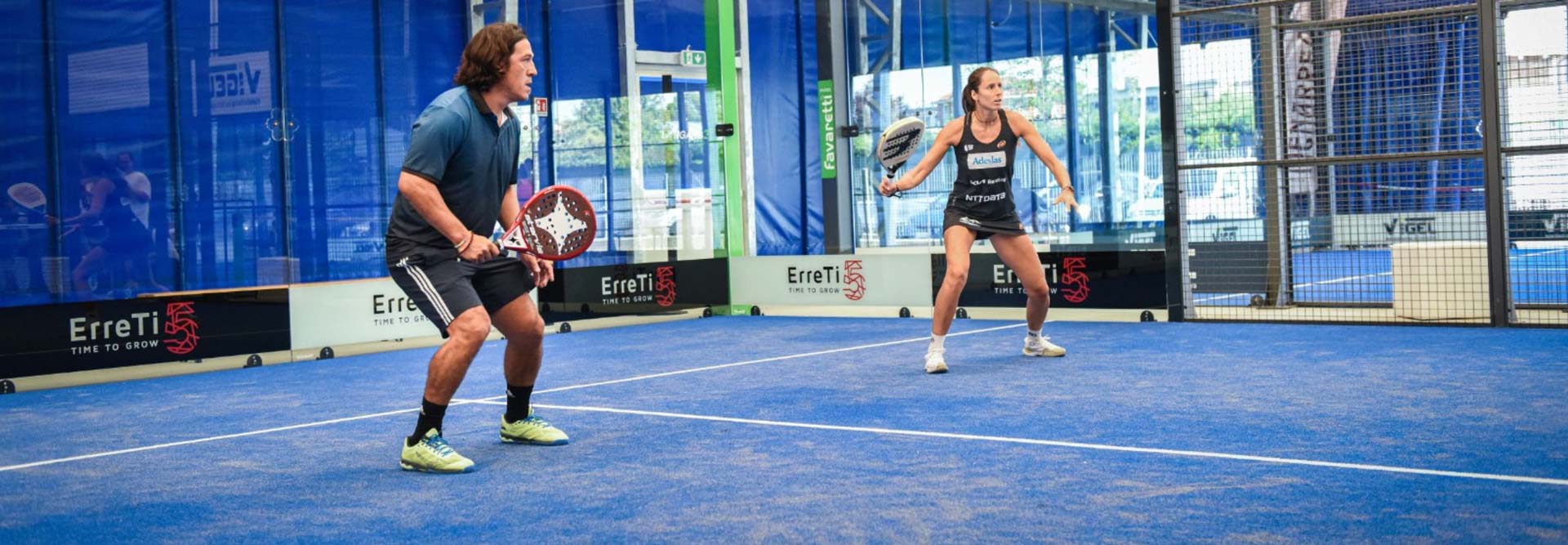
The flooring of a padel court is designed to ensure the best balance between playing performance, safety and durability. It consists of two main elements: the sub-base and surface layer. The sub-base is the structural foundation on which the entire court rests, and to be solid and stable, it must meet the following criteria:
- Be made of concrete or cement
- Be reinforced with a metal mesh
- Have a minimum thickness of 20 cm.
What Materials Are Used for Padel Court Flooring?
For the surface layer, the most widely used material is artificial turf, a versatile and high-performance solution that is perfectly suited to the demands of padel.
The artificial turf used for padel courts has a maximum pile height of 15 mm, a standard set by regulations to ensure consistent ball bounce and good grip for players.
This type of surface can be made using a variety of technologies, each offering unique characteristics. Favaretti Padel courts, for example, are available in three main models, each designed to meet specific needs:
- Fibrillated: carpet with a dense, long-cut fiber structure that delivers excellent grip and resilience, maintaining consistent performance over time, while also providing a high-end aesthetic finish.
- Monofilament: characterized by straight fibers with a central rib, allowing the surface to spring back to its original shape after play. Ensures a fast, consistent bounce while reducing ball wear and improving overall playability.
- Textured: next-generation artificial turf made from straight and semi-concave monofilaments. It ensures stability, high performance and durability, and is used on the center courts of the World Padel Tour for the highest level of professional play.
Investing in the right materials and a professional installation is essential for getting the best performance from a padel court. A quality flooring system not only improves safety and comfort, but also guarantees smooth, precise and enjoyable play, while reducing long-term maintenance costs.
Padel Court Surface Installation Techniques
Installing the turf on padel courts is a complex process that requires precision and attention to ensure a stable, high-performing and safe surface. Everything begins with the preparation of the sub-base, which forms the foundation of the court. This must be built using materials such as porous concrete or standard concrete, ensuring a minimum gradient, generally 1%, to facilitate water drainage on outdoor courts. Before proceeding, the sub-base is carefully inspected to make sure it is free of irregularities, cracks or unevenness that could compromise the synthetic surface.
Once the sub-base is complete, the process moves on to laying the surface carpet. The artificial turf is positioned with extreme care to avoid folds or overlaps. The edges are firmly secured using specialized adhesives or mechanical anchoring systems, ensuring a durable and long-lasting installation.
For synthetic turf surfaces, the sand infill is a fundamental step. The sand is evenly distributed across the entire surface to stabilize the fibers and improve ball bounce. Thorough brushing, done manually or using dedicated machines, allows the sand to penetrate between the fibers and distribute evenly, ensuring a uniform and compact surface. Once installation is complete, rigorous final inspections are carried out to ensure the flooring meets all the requirements for a padel court.
How to Maintain Padel Court Flooring
Maintenance of padel courts is essential for player safety. A key part of this upkeep is caring for the synthetic turf surface, which is the foundation of playing quality.
Here are some essential practices to keep your padel court in top condition:
- Regular cleaning: remove dirt, debris and dust using specialized brushes or brushing machines to prevent them from affecting ball bounce and traction.
- Sand check: for synthetic turf courts, check and redistribute the sand infill to ensure surface stability and proper court behaviour.
- Seam inspection: check that the carpet edges and fastenings are secure to prevent shifting or lifting.
- Drainage management: for outdoor courts, keep the drainage channels clear to prevent water pooling that could damage the sub-base.
- Emergency repairs: address any damage to the surface carpet or sub-base with professional intervention when necessary.